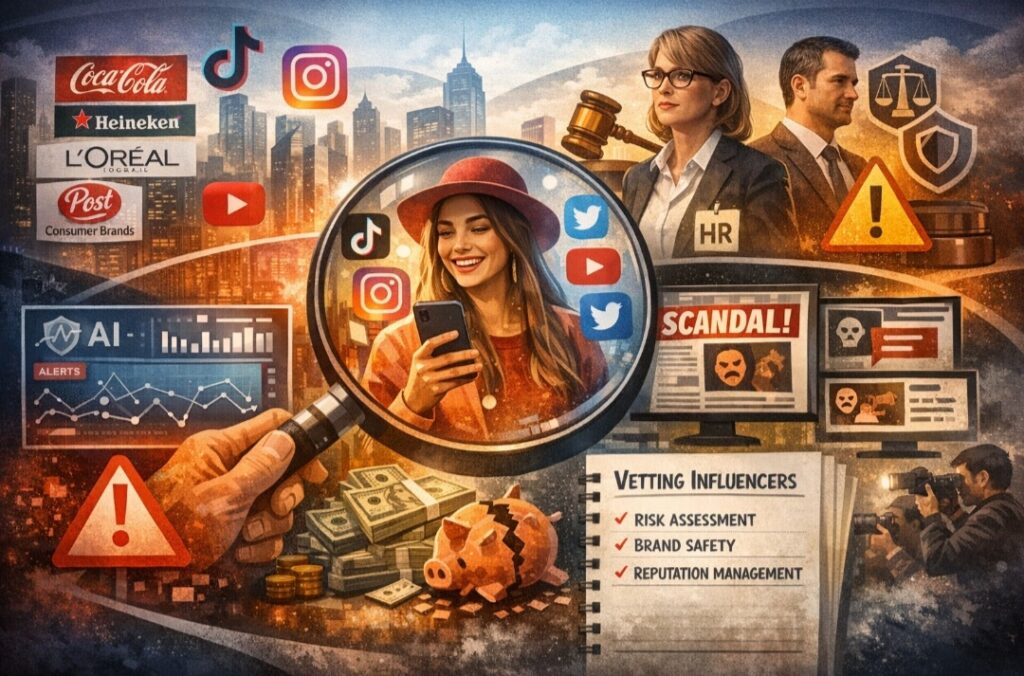

Over the past several years, I’ve had the opportunity to work closely with HR leaders, brand teams, and executive stakeholders at organizations such as Coca-Cola, Heineken, Post Consumer Brands, L’Oréal Luxe Division, Xerium Technologies, CooperSurgical, Roche Bobois Paris, Siemon, and many others. While these companies span very different industries, they all share one reality:
Social media has become a leading paid channel—especially on TikTok and Instagram—and that shift has fundamentally changed how brands are built, scaled, and protected.
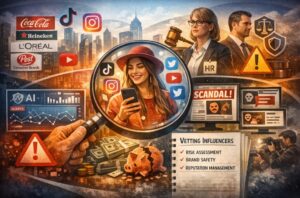
What often prompts these organizations to take my call—or reach out proactively—is not curiosity alone. It’s recognition. Recognition that socially driven campaigns now sit at the intersection of marketing, HR, legal, and risk. Recognition that one creator, one post, one clip, or one resurfaced comment can amplify years of brand equity—or unravel it in seconds.
This article is written for HR leaders, business owners, brand leaders, and agency partners who are navigating that shift and asking a harder, more uncomfortable question:
How are we screening the people who now speak for our brand?
The New Reality: Influencers Are Not Just Marketing Assets
Creators and influencers on platforms like TikTok, Instagram, YouTube, Facebook (Meta), and X are no longer fringe marketing experiments. They are distribution engines.
A single creator can:
- Pitch a product to millions in under 30 seconds
- Drive flash sales overnight
- Reframe brand perception instantly—positively or negatively
Sell not just products, but ideas, values, and behaviors
For growth teams, this is powerful. For HR and brand leaders, it’s also risky.
Unlike traditional employees, influencers often:
- Operate independently
- Have long digital histories that predate brand partnerships
- Speak casually, emotionally, and publicly
- Blur personal opinion with brand affiliation
That combination makes vetting essential—but also incredibly complex.
Why HR Is Now at the Center of Brand Protection
Historically, HR screened candidates while marketing managed brand voice. Today, those responsibilities overlap.
Candidates, employees, brand ambassadors, creators, and influencers all leave digital footprints. What they post, like, share, or resurface can impact:
- Employer brand
- Customer trust
- Investor confidence
- Regulatory exposure
- Revenue
In my work with enterprise organizations and high-growth brands, one theme keeps surfacing:
“We care deeply about our reputation—but we don’t have a scalable way to manage it.”
That gap is where risk lives.
The Questions Every HR and Brand Leader Should Be Asking
Rather than making assumptions, the most effective organizations start with discovery. These are the exact questions I pose—word for word—to HR leaders, brand executives, and agency partners.
Question 1: Creator & Influencer Engagement
- Do you currently manage any creators?
- Do you work with influencers?
- Do you currently work with any active influencers?
Typical responses:
- No
- Yes – We have worked with them before and/or launched a campaign
- Yes – We currently have XXX number of active influencers
Question 2: Social Media Review in Hiring
- When hiring for a role, do you ever review a candidate’s social media profiles?
Typical responses:
- Yes – Occasionally, but we don’t have a system in place
- Yes – We review each person carefully across XXX platforms
- No
Question 3: Social Screening as a Standard Practice
- Do you think it makes sense for companies to conduct social media screening in addition to a background check?
Typical responses:
- Never thought of it
- Yes, but we don’t do that today
- No, that feels like an invasion of privacy
Question 4: Brand Reputation at Scale
- Do you care about what’s being said about your brand online?
- How do you manage the scalability of that?
- How do you manage your brand reputation today?
Typical responses:
- Of course—we care, but we don’t have a formal process
- We use a tool or vendor (often a competitor)
Question 5: Crisis Experience
- Have you ever experienced a PR issue related to something an employee or influencer posted on social media?
Typical responses:
- Yes—and we handled it reactively
- No—not yet
Question 6: Ongoing Monitoring
- How do you currently manage what employees, influencers, users, or customers are saying about your brand on TikTok, Instagram, Twitter/X, and beyond?
Typical responses:
- We have a dedicated internal team
- We use a third-party tool
Question 7: Influencer Vetting
- How do you vet influencers after they apply to work with you?
Typical responses:
- We interview them carefully to ensure brand fit
- Follow-up: How do you ensure they remain a fit in the future?
- We have a team dedicated to this
- We use a tool
The Agency Perspective: What Are You Really Trying to Solve?
When speaking with agencies and partners, the conversation broadens.
Agency Question 1: Objectives
- What are you trying to do?
- Launch a new product, service, or rebrand
- Increase social presence
- Crack TikTok and/or Instagram
- Source and manage high-performing creators
Agency Question 2: Defining Success
- What does success look like?
Impressions, views, clicks, conversions, CAC reduction - Increased brand awareness on TikTok and Instagram
- Entry into new markets and audiences
Agency Question 3: Past Marketing Efforts
- Paid ads and media
- Sponsored events
- Influencer campaigns (past or current)
- Experiential marketing
Agency Question 4: Agency Experience
- Have you worked with agencies before?
- If yes: Who?
- If no: Why not? In-house preference? Prior experience?
Agency Question 5: Influencer Maturity
- Have you executed influencer campaigns before?
- Do you manage influencers internally?
These answers tell a story—not just about marketing sophistication, but about operational readiness and risk tolerance.
The Cost of Getting This Wrong
Here’s what many leaders don’t realize until it happens:
- A single social media incident can cost up to $4.3 million
- Manual reviews don’t scale across platforms, languages, or media types
- Legal reviews can cost $4,000+ per profile
Meanwhile, brand damage doesn’t wait for approval workflows.
Why AI-Powered Social Screening Has Become Essential
The organizations I work with are increasingly turning to AI-powered platforms to:
- Automatically screen social profiles from inception
- Monitor posts, comments, audio, video, and text
- Analyze content in 13+ languages
Provide real-time alerts - Enable faster incident response
This approach:
- Eliminates hundreds of manual hours
- Reduces legal spend
Protects brand equity proactively—not reactively - Creates a single source of truth for HR, legal, and marketing
Most importantly, it allows teams to onboard confidently—whether that’s a new hire, a brand ambassador, or a creator with millions of followers.
A Question Worth Sitting With
If you’re reading this as an HR leader, brand executive, or business owner, ask yourself:
“Are we actively promoting and protecting our brand—or are we hoping nothing goes wrong?”
Because today, hope is not a strategy.
The companies that win in this new era aren’t just louder on social. They’re smarter, more intentional, and better prepared.
And the smartest ones start by asking the right questions—before the internet asks them for you.
#HRLeadership #BrandProtection #InfluencerMarketing #SocialMediaRisk #EmployerBrand #TikTokMarketing #InstagramMarketing #CreatorEconomy #ReputationManagement #AIinHR #BrandSafety #DigitalTrus
About The Author