How do you structure your day-to-day in a B2B SaaS sales environment to maximize operational efficiency and create more revenue-generating opportunities through customer outreach over an 8–10 hour workday?
One of the most impactful professional experiences I’ve had was working within a highly integrated B2B SaaS outbound sales environment where multiple platforms, workflows, and embedded tools operated together to create a streamlined, process-driven system designed for one core objective: increasing customer-facing efficiency.
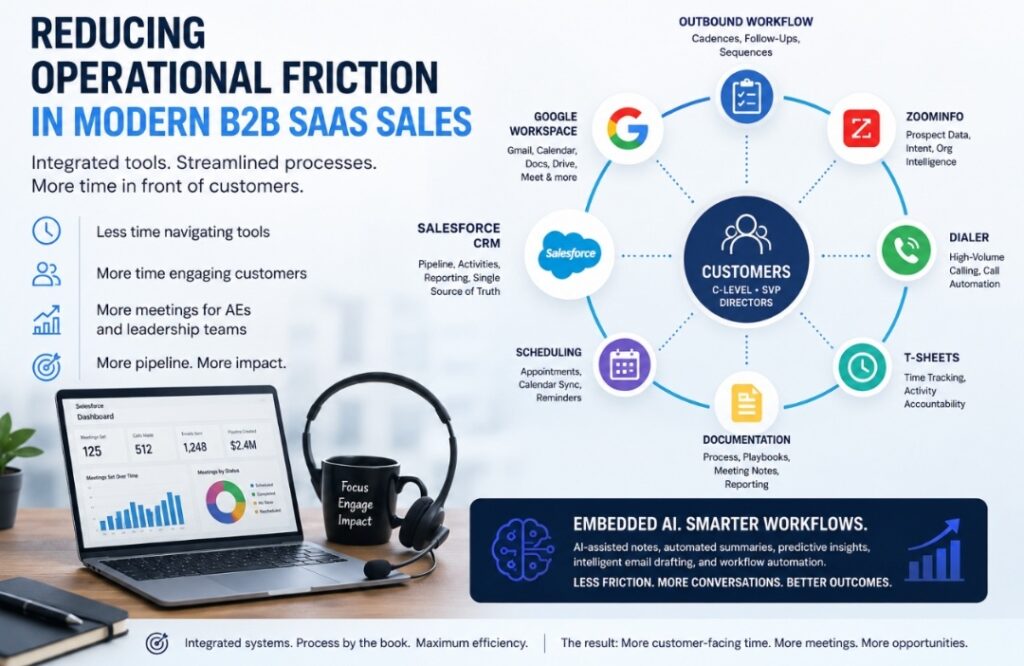
The workspace was built around the Google ecosystem — Gmail, Google Calendar, Google Chrome, Google Meet/Video, Google Docs, spreadsheets, and shared drives — forming the daily operational foundation for communication, documentation, and coordination.
Alongside this were core revenue and sales systems including Salesforce CRM, ZoomInfo, dialers, cadence management tools, scheduling platforms, T-Sheets, research databases, and structured workflow documentation. Each tool served a specific function within a larger operational architecture.
What stood out most was not any single platform, but how the system functioned as a whole.
The environment was designed to reduce operational friction — minimizing the time spent switching between tools, manually organizing data, or navigating disconnected systems. Instead, it allowed focus to remain on the highest-value activity: engaging directly with customers and decision-makers.
That efficiency directly supported outbound sales development efforts aimed at generating meetings for Account Executives (AEs), managing partners, and senior leadership teams. The process was highly structured and consistent:
• Outbound cold calling. • Multi-touch cadence execution
• Follow-up sequencing
• Appointment setting
• CRM updates and pipeline management
• Meeting notes and documentation
• Calendar coordination
• Activity tracking and KPI reporting
• Team communication and handoffs
The objective remained clear throughout: Create consistent outbound engagement that led to qualified meetings with C-level executives, Senior Vice Presidents, Directors, and enterprise decision-makers.
A typical workflow could move seamlessly from prospect identification in ZoomInfo, to enrichment and research, into Salesforce CRM, followed by cadence enrollment, outbound dialing and emailing, scheduling through integrated calendar tools, and finally documentation and pipeline advancement — all within a connected operational system.
Everything was built “by the book,” with defined processes, accountability structures, and repeatable workflows designed to ensure consistency, scalability, and measurable performance across teams.
As the experience evolved, what became increasingly clear was how much operational efficiency depended on system design rather than individual effort alone.
More importantly, emerging embedded AI tools began to further enhance these workflows.
AI-assisted note-taking, automated summaries, predictive lead prioritization, conversational intelligence, intelligent email drafting, and workflow automation are increasingly shaping how modern B2B SaaS sales organizations operate. These tools reduce administrative overhead while improving accuracy, speed, and decision-making support across revenue teams.
Looking at where the industry has moved since this was first written: the gap is no longer “AI or no AI.” Roughly 87% of B2B sales orgs now use some form of AI, but only about 24% have moved to genuinely agentic AI — systems that don’t just assist a rep but autonomously run parts of the workflow: qualifying leads, drafting and sending sequences, updating CRM records, and triggering next-best-actions without a human pressing every button. R[AI]SING
That split is showing up directly in performance. Organizations running agentic sales systems report average ROI north of 170%, with revenue lifts of 3–15% and sales ROI improvements of 10–20%. ReadinessOne documented case cut lead response time from 47 hours to 9 minutes and reduced admin time per call from 75 minutes to 2 — outcomes, not projections. Salesforce’s 2026 State of Sales report found 94% of sales leaders using agents call them critical to meeting business demands, and top-performing teams are 1.7x more likely to use them than struggling ones.
This reinforces a broader shift in the industry: B2B SaaS sales is no longer just about tools — it is about integrated ecosystems.
CRM systems, outbound engagement platforms, data intelligence tools, and AI-powered layers are converging into unified environments designed to maximize efficiency and reduce friction between systems, processes, and people.
In 2026 this convergence has a name: the CRM has become the operating surface for AI. Agents now act inside the record itself — Salesforce Agentforce, HubSpot Breeze, Microsoft Copilot for Sales — drafting outreach, summarizing calls, and taking action without the rep switching tools. The platform-consolidation trend (Gong absorbing forecasting and enablement, Salesforce bundling everything into Agentforce) is the market correcting for exactly the fragmentation problem this piece describes: a stack of seven disconnected AI tools performs worse than four that actually talk to each other.
In practice, this shift does something very simple but very important:
It reduces the time spent navigating tools and increases the time spent in front of customers.
That outcome directly supports outbound success — enabling more effective engagement, more structured pipeline generation, and more consistent meeting creation for AEs and leadership stakeholders.
The numbers now back this up at scale: teams using AI-driven agents and predictive deal scoring are closing complex deals in 41 days instead of 64 — a 36% faster cycle — while manual teams lose an average of 21 extra hours per rep, per month, to admin work that AI-powered teams no longer touch lock-in
One more shift worth naming: friction is starting to disappear on the buyer’s side too, not just the seller’s. A growing share of B2B buyers now research and even negotiate through their own AI agents before a human rep ever gets involved, and Gartner projects up to 90% of B2B buying interactions will involve agents by 2028. The operational discipline this piece describes — clean data, structured workflows, consistent process — is exactly what makes a seller’s systems legible to a buyer’s AI agent, not just to a human prospect.
Ultimately, reducing operational friction is not just an efficiency improvement. It is a structural advantage in modern B2B SaaS sales organizations where scale, consistency, and execution discipline determine outcomes.
Worth balancing this with a caution the data also raises: Gartner projects that by 2030, 75% of B2B buyers will still prefer human interaction over AI for complex or high-stakes transactions. Agentic AI is compounding the operational advantage — but the relationship-driven, high-stakes conversation isn’t disappearing. It’s being protected by everything AI is now clearing off a rep’s plate.
The future of this space is not defined by more tools, but by better integration, smarter workflows, and embedded intelligence that allows sales professionals to focus less on systems — and more on relationships, conversations, and revenue creation.
Sources:
• “GEO in June 2026: The Methods and Metrics That Actually Work” — June 4, 2026. Read the R[AI]SING SUN article R[AI]SING SUN
• “Enterprise AI Readiness Gap 2026: 5 Barriers Beyond Talent” — May 29, 2026. Read the AI Readiness article
• “AI Vendor Lock-In vs Vendor-Agnostic Architecture (2026)” — June 21, 2026.
Read the vendor lock-in article
• “$6 AI Agents vs $10 Offshore: Labor Economics That Broke in 2026” — August 12, 2026.
Read the AI agents article
About The Author