
Strategy and planning are not theoretical exercises in B2B marketing — they are the foundation that determines whether a company grows or stalls. In complex environments like SaaS, where multiple stakeholders, long sales cycles, and high-value decisions are the norm, success rarely comes from isolated tactics. It comes from alignment. Insights from Forbes and Gartner consistently reinforce that high-performing B2B organizations win because they connect strategy directly to execution across every part of their go-to-market approach.
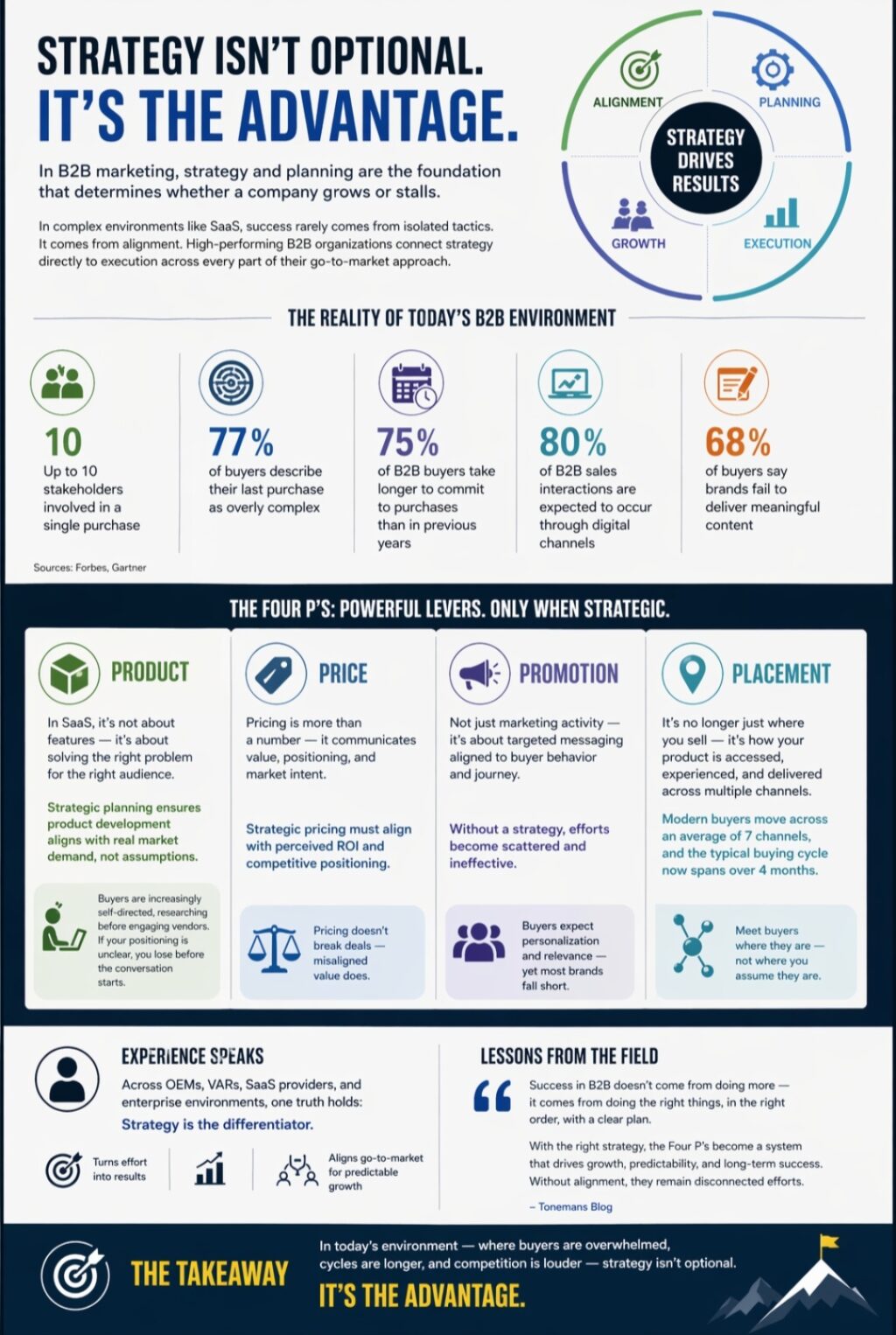
The reality is that today’s B2B environment is more complex than ever. A single purchase can involve up to 10 stakeholders, and 77% of buyers describe their last purchase as overly complex, often due to information overload and unclear direction . At the same time, buying cycles are stretching — with research showing 75% of B2B buyers take longer to commit to purchases than in previous years . Without a clear strategy guiding decisions, organizations get lost in that complexity. Forbes
At the center of navigating this environment are the Four P’s: Product, Price, Promotion, and Placement. While these concepts are often introduced early in marketing education, their real power is only realized when they are driven by a clear strategic plan. Without that foundation, even strong products or aggressive sales efforts fail to gain traction.
Product, in a SaaS environment, is not just about features — it’s about solving the right problem for the right audience. Strategic planning ensures that product development aligns with real market demand, not assumptions. This matters even more today, as buyers are increasingly self-directed — spending a significant portion of their journey researching independently before engaging vendors . If your product positioning is unclear, you lose before the conversation even starts. Gartner
Pricing is another area where strategy plays a defining role. In B2B SaaS, pricing is more than a number — it communicates value, positioning, and market intent. Strategic pricing must align with perceived ROI and competitive positioning. Without it, companies risk either undervaluing their solution or pricing themselves out of consideration. As many B2B leaders have learned, pricing doesn’t break deals — misaligned value does.
Promotion, often mistaken as simply marketing activity, is where many organizations lose focus without a strategic anchor. Effective promotion in B2B requires targeted messaging aligned to buyer behavior. Today, that behavior is rapidly evolving. For example, research shows that 80% of B2B sales interactions are expected to occur through digital channels, forcing marketing teams to rethink how they engage buyers across content, social, and outbound efforts (Forbes). At the same time, buyers expect personalization and relevance — yet 68% say brands fail to deliver meaningful content, highlighting a major gap between effort and execution Forbes
Placement — or distribution — has also evolved significantly in SaaS. It’s no longer just about where a product is sold, but how it is accessed, experienced, and delivered across multiple channels. Modern B2B buyers move across an average of seven channels during their journey, and the typical buying cycle now spans over four months �. Strategic planning ensures that organizations meet buyers where they are — not where they assume they are. Gartner
From my own experience working across OEMs, VARs, SaaS providers, and enterprise environments, I’ve seen firsthand that strategy is the differentiator. It’s what turns effort into results. Whether building pipeline, refining outreach, or aligning go-to-market execution, the organizations that take the time to plan outperform those who simply react.
This is a perspective I’ve continued to develop and share through my own writing, including on Tonemans Blog, where I focus on real-world applications of strategy, planning, and execution. The consistent theme is simple: success in B2B doesn’t come from doing more — it comes from doing the right things, in the right order, with a clear plan.
For SaaS leaders today, the takeaway is clear. The Four P’s are not outdated concepts — they are powerful strategic levers. But without alignment, they remain disconnected efforts. With the right strategy in place, they become a system that drives growth, predictability, and long-term success.
In today’s environment — where buyers are overwhelmed, cycles are longer, and competition is louder — strategy isn’t optional.
It’s the advantage.
About The Author