
Updated September 2026
Business development has changed.
In today’s B2B environment, growth is no longer driven simply by adding more prospects, making more calls, booking more meetings, or expanding into another market.
Buyers are more informed, more self-directed, and increasingly using AI to research companies, evaluate solutions, compare vendors, and validate information before engaging with sales.
Gartner reports that 45% of B2B buyers surveyed had used GenAI during a recent purchase, while 67% preferred a rep-free buying experience. At the same time, 69% said they turn to sales representatives to validate AI-generated insights.
That creates a new challenge for B2B organizations:
How do you become relevant before the buyer enters the sales conversation—and valuable once they do?
The answer isn’t simply more technology.
It requires a connected business development strategy built around the right customers, the right message, the right channels, and measurable revenue outcomes.
What Is a Modern B2B Business Development Strategy?
A modern business development strategy is a structured approach to identifying opportunities, reaching the right accounts, creating customer relevance, developing relationships, and converting market demand into measurable revenue.
The traditional funnel still matters:
Identify → Engage → Qualify → Convert → Expand
But the way buyers move through that funnel has changed.
B2B buyers now move between websites, search, social platforms, AI tools, digital content, sales conversations, peer recommendations, demonstrations, and other channels.
McKinsey’s 2026 Global B2B Pulse Survey found that B2B buyers use an average of 10 channels during the purchasing journey and increasingly expect consistent experiences across those channels.
That means business development can no longer operate as an isolated outbound function.
It must connect:
Market Intelligence + ICP + Messaging + AI + Sales + Marketing + RevOps + Customer Experience
When these elements work together, business development becomes more than lead generation.
It becomes a revenue growth system.
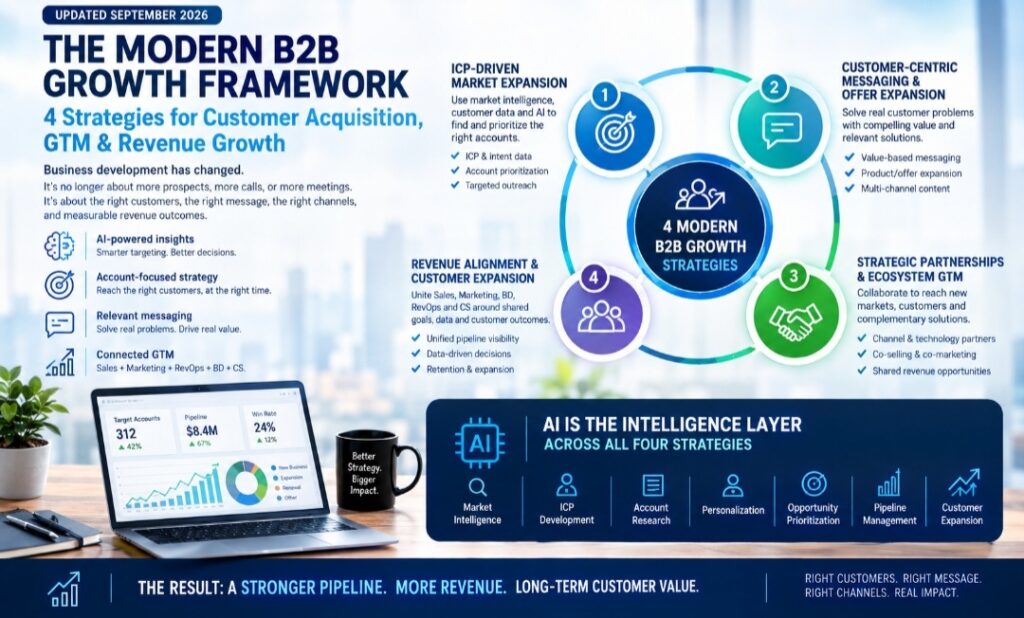
The 4 Modern B2B Growth Strategies
1. ICP-Driven Market Expansion
Market expansion remains one of the most powerful ways to create growth—but simply entering a new market is not a strategy.
The critical question is:
Which customers are most likely to have the problem you solve, the urgency to address it, and the ability to buy?
That starts with defining and continuously refining the Ideal Customer Profile (ICP).
A modern ICP can incorporate:
- Industry
- Company size
- Revenue
- Geography
- Technology environment
- Business model
- Growth stage
- Organizational structure
- Buying signals
- Existing technology
- Business challenges
- Trigger events
- Intent data
- Historical customer performance
AI can accelerate the research process by helping sales and marketing teams identify patterns across large amounts of account and market data.
But AI does not replace strategy.
It amplifies the quality of the strategy behind it.
From broad prospecting to precision targeting
Instead of asking:
“Who can we sell to?”
Modern GTM teams should ask:
“Which accounts have the strongest combination of fit, need, timing, and buying potential?”
This changes prospecting from activity generation into account prioritization.
For example, an organization entering a new vertical might identify 5,000 potential companies.
A traditional approach may attempt to contact as many as possible.
An ICP-driven approach might identify the 300 accounts showing the strongest combination of firmographic fit, technology compatibility, business triggers, and buying signals.
The objective isn’t more accounts.
It’s better accounts.
2. Customer-Centric Messaging & Offer Expansion
Finding the right customer is only half the equation.
You also need a reason for that customer to care.
This is where messaging, positioning, value propositions, and product or service expansion intersect.
Traditional diversification often asks:
“What else can we sell?”
A customer-centric approach asks:
“What additional problems can we solve for the customers we already understand?”
That distinction matters.
Product and service expansion should be connected to actual customer needs rather than simply creating additional offerings.
Strong B2B messaging connects four elements:
Customer Problem → Business Impact → Solution → Measurable Value
Instead of leading with product features, effective B2B messaging should communicate:
- What problem exists?
- Why does it matter now?
- What does the problem cost the organization?
- How does the solution address it?
- What business outcome can the customer expect?
This becomes even more important as AI changes how buyers research vendors.
Gartner’s 2026 research indicates that buyers increasingly use AI and digital channels to conduct research independently, while still relying on salespeople at important decision points to validate information and reduce uncertainty.
That means your messaging must work before the salesperson enters the conversation.
Your website, content, case studies, value proposition, product information, and sales outreach should reinforce the same story.
AI changes the speed of messaging—not the need for relevance
AI can help generate variations, analyze accounts, identify relevant themes, summarize research, and personalize communication.
The advantage comes from combining AI with:
ICP knowledge + customer insight + business context + human judgment.
3. Strategic Partnerships & Ecosystem GTM
Growth doesn’t always have to come directly from your own sales organization.
Strategic partnerships can create access to:
- New markets
- New customers
- New technologies
- Distribution channels
- Industry expertise
- Credibility
- Complementary products
- Shared demand-generation opportunities
For B2B companies, partnerships can include:
OEMs | VARs | MSPs | Technology Partners | Channel Partners | Consultants | Integrators | Referral Partners | Strategic Alliances
The strongest partnerships are not simply logo exchanges.
They create mutual economic value.
A modern partnership strategy should answer:
- Who already has access to our ideal customers?
- What do they provide that complements our offering?
- What do we provide that creates value for their customers?
- How will opportunities be identified and qualified?
- How will leads or opportunities move between organizations?
- How will revenue attribution be measured?
This transforms partnerships from informal networking into a structured go-to-market channel.
Partnerships can also strengthen market expansion.
Instead of entering a new market alone, an organization may leverage an established partner’s customer relationships, distribution network, technical expertise, or market credibility.
The result can be a more efficient path to customer acquisition.
4. Revenue Alignment & Customer Expansion
The fourth strategy brings everything together.
A company can have excellent products, strong marketing, sophisticated technology, and talented salespeople—and still struggle to grow if its revenue functions operate independently.
Modern B2B growth requires alignment across:
Sales + Marketing + Business Development + RevOps + Customer Success
Everyone should have visibility into the same fundamental questions:
- Who is our ICP?
- Which accounts matter most?
- What problems are we solving?
- What messaging is working?
- Where are opportunities coming from?
- Which channels are producing pipeline?
- Where are prospects dropping out?
- Which customers are expanding?
- What does the data tell us?
Pipeline should be treated as a managed asset
Generating activity is not the same as generating revenue.
A modern pipeline strategy should measure more than:
- Calls
- Emails
- Meetings
- Activity volume
It should also examine:
- Qualified opportunities
- Conversion rates
- Opportunity progression
- Deal quality
- Sales velocity
- Pipeline coverage
- Forecast accuracy
- Customer acquisition efficiency
- Expansion revenue
- Customer retention
McKinsey’s 2026 research identifies fragmented data, disconnected teams, manual processes, and weak insights as barriers to capturing value from AI. Its research points toward redesigning commercial workflows around the customer and seller rather than simply adding more AI tools.
That’s an important distinction.
AI should not simply automate a broken revenue process.
It should help organizations build a better one.
AI Is the Intelligence Layer Across All Four Strategies
AI shouldn’t necessarily be treated as a fifth business development strategy.
It is better understood as an intelligence layer across the entire GTM system.
AI can support:
Market Intelligence
Identify accounts, markets, trends, buying signals, and trigger events.
ICP Development
Analyze existing customers and identify characteristics associated with stronger-fit accounts.
Account Research
Rapidly synthesize company, technology, leadership, financial, and market information.
Personalization
Create more relevant messaging based on account-specific business conditions.
Opportunity Prioritization
Help sales teams focus attention where the combination of fit, intent, timing, and opportunity is strongest.
Pipeline Management
Identify gaps, stalled opportunities, conversion patterns, and areas requiring intervention.
Customer Expansion
Surface potential cross-sell, upsell, renewal, and expansion opportunities.
But the objective should remain the same:
Use technology to improve decisions, customer relevance, productivity, and measurable business outcomes.
McKinsey’s July 2026 research makes a similar distinction: the companies capturing greater value from AI are redesigning commercial workflows rather than simply deploying isolated AI tools.
The Modern BDR: From Activity Generator to Revenue Contributor
The role of the BDR/SDR is also changing.
The modern BDR is not simply measured by the number of calls made or meetings booked.
Effective BDR execution begins with:
ICP Understanding → Account Intelligence → Relevant Messaging → Multi-Channel Engagement → Qualification → Opportunity Creation
The BDR must understand:
- Who the customer is
- Why the account matters
- What business problem may exist
- Why the problem may matter now
- Who is involved in the buying process
- What evidence indicates potential need
- Whether the opportunity is worth advancing
This requires stronger collaboration between Sales, Marketing, RevOps, and Business Development.
The objective is not to manufacture meetings.
It is to create qualified conversations that have a legitimate path to revenue.
From Activity to Outcomes
One of the biggest changes in B2B business development is the shift from measuring activity to measuring impact
Activity still matters.
But activity without relevance creates noise.
A modern revenue organization should continuously examine the relationship between:
Activity → Engagement → Qualification → Opportunity → Revenue → Customer Value
This creates a closed-loop system.
When an opportunity converts, the organization should learn from it.
When an opportunity doesn’t convert, the organization should learn from that too.
Over time, those insights should improve:
- ICP definition
- Messaging
- Targeting
- Qualification
- Sales processes
- Marketing campaigns
- Product positioning
- Customer expansion
That’s where business development becomes a continuous learning system rather than a collection of disconnected tactics.
The 2026 B2B Growth Framework
The four strategies can be summarized simply:
1. Identify
Find the right customers.
Build and continuously refine the ICP using market intelligence, customer data, intent signals, and AI-assisted research.
2. Engage
Give the right customers a reason to care.
Develop customer-centric messaging based on business problems, urgency, value, and measurable outcomes.
3. Expand
Create additional routes to growth.
Use partnerships, ecosystem relationships, new markets, and complementary products or services to expand reach and customer value.
4. Align
Connect the revenue engine.
Align Sales, Marketing, Business Development, RevOps, and Customer Success around common data, messaging, pipeline visibility, and customer outcomes.
And across all four:
Apply AI as an intelligence and productivity layer—with human judgment remaining central to strategy, trust, and complex buying decisions.
Final Thought
B2B business development in 2026 isn’t about simply doing more.
It’s about knowing more, targeting better, communicating relevance, and executing with greater precision.
The companies creating sustainable growth will increasingly be those that connect customer intelligence with disciplined GTM execution.
They will understand their ideal customers.
They will recognize buying signals earlier.
They will deliver relevant messaging across multiple channels.
They will use AI to increase intelligence and execution speed.
They will align Sales, Marketing, RevOps, Business Development, and Customer Success around measurable outcomes
And they will continually turn customer and pipeline data into better decisions.
The modern business development advantage isn’t activity volume.
It’s the ability to consistently turn customer intelligence into qualified pipeline, revenue, and long-term customer value.
About The Author